Tuesday, June 13, 2023

Jews Take Their Part in Helping Set Forth a New Nation- Part 2 for American Jewish Heritage Month


Jews Take Their Part in Helping Set Forth a New Nation- Part 2 for American Jewish Heritage Month

June 10 2023

Follow the link for the video discussion

https://youtu.be/KFYORqfJ3EY


( In my online discussion, I open with a display of some reprints of early Jewish sermons from the early years of the new America)


Despite these obstacles, the Jews fought for their rights and freedoms. In 1655, they obtained permission to bury their dead in a Jewish cemetery and the right to trade on the Hudson & Delaware Rivers. In 1656, they petitioned for equal rights with other citizens of the colony. They argued that they paid the same taxes and were willing to serve in the militia. They were led in these fights by Jacob Bar Simson and Asser Levy. They eventually won their case and gained more rights.


In 1664, New Amsterdam was captured by the British and renamed New York. The British rule brought some changes for the Jewish community. The Jewish population in America grew slowly over time. From 23 to 300 a decade later


In New York by 1700 there was a synagogue on Beacon St. Then by 1730s was the founding of Shearith Israel, the Spanish and Portuguese synagogue as it is known today. Jewish Settlements were spreading throughout the colonies and then States. In Newport RI where there were 12 hundred Jews ( almost half of all the Jews) and the establishment of  the Touro synagogue, the oldest standing synagogue in the country.


( Wikipedia-Commons)

Touro University, whose branch is in this building, is named after Judah and Isaac Touro, one of the philanthropists who paid for the property. There is another Touro Synagogue in New Orleans, also very old, which the Touro’s helped finance.

For a virtual tour , you can go to https://tourosynagogue.org

  Jews had settled in Philadelphia before 1682, and spread south to the Carolinas and Georgia . 

    By 1776, there were about 3,000 Jews, about 1/10 of 1 %, in America, mostly of Spanish origin.

What was life like for Jews in these early days?:

 Letter from Rebecca Samuel, c. 1790s

Dear Parents:

I hope my letter will ease your mind. You can now be reassured and send me one of the family to Charleston, South Carolina. This is the place to which, with God’s help, we will go after Passover. The whole reason why we are leaving this place is because of [its lack] of Yehudishkeit [Jewishness].

Dear parents, I know quite well you will not want me to bring up my children like Gentiles. Here they cannot become anything else. Jewishness is pushed aside here. There are here [in Petersburg, Virginia] ten or twelve Jews, and they are not worthy of being called Jews. We have a shohet [slaughterer of animals and poultry] here who goes to market and buys terefah [nonkosher] meat and then brings it home. On Rosh Ha-Shanah and on Yom Kippur the people worshipped here without one Sefer Torah, and not one of them wore the tallit or the arba kanfot, except Hyman and my Sammy’s godfather. The latter is an old man of sixty, a man from Holland. He has been in America for thirty years already; for twenty years he was in Charleston, and he has been living here for four years. He does not want to remain here any longer and will go with us to Charleston. In that place there is a blessed community of three hundred Jews.

You can believe me that I crave to see a synagogue to which I can go. The way we live now is no life at all. We do not know what the Sabbath and the holidays are. On the Sabbath all the Jewish shops are open, and they do business on that day as they do throughout the whole week. But ours we do not allow to open. With us there is still some Sabbath. You must believe me that in our house we all live as Jews as much as we can.

As for the Gentiles, we have nothing to complain about. For the sake of a livelihood we do not have to leave here. Nor do we have to leave because of debts. I believe ever since Hyman has grown up that he has not had it so good. You cannot know what a wonderful country this is for the common man. One can live here peacefully….

All the people who hear that we are leaving give us their blessings. They say that it is sinful that such blessed children should be brought up here in Petersburg. My children cannot learn anything here, nothing Jewish, .

I remain, your devoted daughter and servant,
Rebecca, the wife of Hayyim, the son of Samuel the Levite

Letter written by Rebecca Samuel in Yiddish in the 1790s (exact date unknown); sent from Petersburg, Virginia to Hamburg, Germany.

HOW TO CITE THIS PAGE

Jewish Women's Archive. "Letter Written by Rebecca Samuel." (Viewed on May 11, 2023) <https://jwa.org/node/25212>.


[As a side note, I served as Rabbi in Newport News, about an hour away, not far from Jamestown, the first English settlement, took course work in colonial Williamsburg, College of William and Mary, dined at a famous fish restaurant at Yorktown, the site of the British surrender in the Revolutionary War. Our son was born in a hospital overlooking the harbor where the first battle of modern battleships was fought.  And a ton of other history in a small area!]


Jews took their active part in the Colonial period and the Revolutionary War even though they were very few in numbers.


For example, Francis Salvador, from a prominent Jewish family in London, came to the colonies to save the family fortune and built up farm lands in South Carolina. He became a real pioneer type, leather stockings and all. He was soon elected to the South Carolina provisional Congress as a representative and he was authorized to issue letters of credit for the new state. He kept the government costs down ,took part in drafting state constitution , and he later died in the battle with Cherokee Indians who were fighting for the British at that time. At age 29, he was the first Jew to die in the war.


https://charlestonmag.com/features/how_francis_salvador_fought_for_the_country_s_independence


Mordecai Sheftall had been chairman of the Parochial committee of Christ Church Parish [that’s a county, not a church fyi ] .The de facto governor of that part of Georgia, the royal governor James Wright protested. “One Sheftall,  a Jew is on the parochial committee. This fellow issues orders to captains of vessels to depart the king's port without landing any of the cargoes legally imported.! “

 He took an active part in the revolutionary government of Georgia and he was captured by the British who called him a “very great rebel.” In jail it is thought that he spoke Yiddish to German soldiers and made friends with them. The British soldiers tormented him by trying to force him to eat pork. He escaped to Charleston from prison in a boat ,was captured again, and this time imprisoned in Antigua and later released. He loaned money for expeditions against Indians and supplies for troops .He was owed $139,000 and got back some $7,682. Sheftall was also a religious Jew and later moved to Philadelphia where he helped build the synagogue, Mikveh Israel, and also served as its president. Benjamin Franklin also contributed!


Wikipedia Commons


Of course, no story of Jews in early America is complete without Haym Salomon:


Wikipedia commons

 Polish-born American businessman who was a principal financier of the fledgling American republic and also a founder of the first Philadelphia synagogue, Mikveh Israel.

In 1772, probably because of his revolutionary activities for Polish liberty, Salomon fled to New York City, where he established himself as a commission merchant

 In 1776 the British, who controlled New York City, arrested Salomon; exposure suffered in prison later contributed to his early death. He was paroled but was arrested again in 1778 on more serious charges; he escaped and went to Philadelphia. There he established a brokerage office and acted without salary as the financial agent of the French, doing all in his power to facilitate the Franco-American Alliance.

Among his many other contributions to the colonies, Salomon subscribed heavily to government loans, endorsed notes, gave generously to soldiers, and equipped several military units with his own money. Robert Morris, the superintendent of finance from 1781 to 1784, appointed Salomon as broker to his office. Morris records in his diary that between 1781 and 1784 Salomon lent more than $200,000. According to some reports, the government owed Salomon more than $600,000, though the exact amount is unknown. At the time of his death in 1785, Salomon was penniless https://www.britannica.com/biography/Haym-Salomon

Statue in Chicago, of Washington, flanked by the financiers of the Revolution, Morris on  the left, Salomon on the right.


Wikipedia commons

 What about the man who shaped the American constitution and gave birth to –a musical?

Did the original Hamilton family look like this?


Wikipedia

Lin Manuel Miranda as Hamiltion or

Or, more probably like this: 


 Hamilton, generally considered a lifelong Christian, may have been born and raised Jewish. It’s an argument made in a new book “The Jewish World of Alexander Hamilton” by University of Oklahoma history professor Andrew Porwancher.

https://www.jewishboston.com/read/does-alexander-hamilton-have-jewish-roots/

 He researched Hamilton’s mother, who was born Rachel Faucette, married a man named Johann Levine and took his surname. It’s a surname that appears in many versions in historical texts, some of which were shared by Jews of the period….

After the Levines had a son, their marriage broke up. Rachel Levine later had two more sons, including Alexander, out of wedlock with a Scottish man named James Hamilton. She enrolled Alexander in a Jewish school on Nevis, which had a significant Jewish population—about one-quarter of the free white population…

 Juxtapose this relative indifference of Christianity with Hamilton’s emergence as a strong defender of Jewish equality in the early years of the American republic, [more] than any other Founding Father.”

The author's premise is that Rachel Faucette may have converted to Judaism when she married Levine, which would have made Hamilton Jewish through his mother !Maybe yes, maybe no, but it is plausible that he had some strong Jewish influence that made him support and defend Jews at a time when they were not accepted into early American society.

Which now begs the question_ what did it take to guarantee our rights here?


Going back to our rights here:

 It was South Carolina that was the first colony back in 1669 to grant freedom of conscience to Jews heathens and dissenters. This was the reasoning:

Article 87  stated: that heathens, Jews, and other dissenters from the purity of Christian Religion may not be Scared and kept at a distance from [knowledge of it, but, by having an opportunity of acquainting themselves with the truth and reasonableness of its Doctrines, and the peaceableness and inoffensiveness of its professors, may, by good usage and persuasion, and all those convincing Methods of Gentleness and meekness Suitable to the Rules and design of the Gospel, be won over to embrace and unfeignedly receive the truth: Therefore, any Seven or more persons agreeing in any Religion shall constitute a church or profession, to which they shall give Some name to distinguish it from others. (https://scholarcommons.sc.edu/cgi/viewcontent.cgi?article=3710&context=sclr)

Thomas Jefferson believed that his claim to fame rested upon the statute of freedom of religion of the state of Virginia, which he promulgated because he observed the persecution of dissenting Christians from the official state religion ( the Church of England.)

“We the General Assembly of Virginia do enact [Be it enacted by the General Assembly] that no man shall be compelled to frequent or support any religious worship, place, or ministry whatsoever, nor shall be enforced, restrained, molested, or burthened in his body or goods, nor shall otherwise suffer, on account of his religious opinions or belief; but that all men shall be free to profess, and by argument to maintain, their opinions in matters of religion, and that the same shall in no wise diminish, enlarge, or affect their civil capacities.”

This state version formed the basis for the very first line of the first amendment to the Constitution, 1788.

Congress shall make no law respecting an establishment of religion, or prohibiting the free exercise thereof;


But did that mean Jews? Jews, by historic memory, were very wary of their standing.


Thus, from the head of the Jewish community of Newport, Rhode Island:to President Washington:

 “Permit the children of the Stock of Abraham to approach you with the most cordial affection and esteem for your person & merits—and to join with our fellow Citizens in welcoming you to New Port.

“Deprived as we heretofore have been of the invaluable rights of free Citizens, we now (with a deep sense of gratitude to the Almighty disposer of all events) behold a Government, erected by the Majesty of the People—a Government, which to bigotry gives no sanction, to persecution no assistance—but generously affording to All liberty of conscience, and immunities of Citizenship: deeming every one, of whatever Nation, tongue, or language, equal parts of the great governmental Machine….

“..., we desire to send up our thanks to the Antient of Days, the great preserver of Men—…, may graciously conduct you through all the difficulties and dangers of this mortal life: and, when like Joshua full of days and full of honour, you are gathered to your Fathers, may you be admitted into the Heavenly Paradise to partake of the water of life, and the tree of immortality” (DLC:GW).”

The clincher was Washington ‘s famous ,in response, echoing some of the wording:

 It is now no more that toleration is spoken of, as if it was by the indulgence of one class of people, that another enjoyed the exercise of their inherent natural rights. For happily the Government of the United States, which gives to bigotry no sanction, to persecution no assistance requires only that they who live under its protection should demean themselves as good citizens, in giving it on all occasions their effectual support.

It would be inconsistent with the frankness of my character not to avow that I am pleased with your favorable opinion of my Administration, and fervent wishes for my felicity. May the Children of the Stock of Abraham, who dwell in this land, continue to merit and enjoy the good will of the other Inhabitants; while every one shall sit in safety under his own vine and fig tree, and there shall be none to make him afraid. May the father of all mercies scatter light and not darkness in our paths and make us all in our several vocations useful here, and in his own due time and way everlastingly happy.

Go: Washington


https://founders.archives.gov/documents/Washington/05-06-02-0135


 Next: The Jews and the Shaping of the United States


Sunday, May 14, 2023

How did Jews first step foot in what would become the United States of America- Part 1 for Jewish American Heritage Month


How did Jews first step foot in what would become the United States of America- Part 1 for Jewish American Heritage Month 


For the video of this discussion:


https://youtu.be/UnCHDjCa-oA


The enduring heritage of Jewish Americans  


Part I Colonies 

 May is Jewish American Heirtage Month so I post here the proclamation by Presdent Biden:

By proclamation of President Biden:

“This month, we celebrate the enduring heritage of Jewish Americans, whose values, culture, and contributions have shaped our character as a Nation.  For generations, the story of the Jewish people — one of resilience, faith, and hope in the face of adversity, prejudice and persecution — has been woven into the fabric of our Nation’s story.  It has driven us forward in our ongoing march for justice, equality, and freedom as we recommit to upholding the principles of our Nation’s founding and realizing the promise of America for all Americans.”


PS It is also  Asian American and Native Hawaiian/Pacific Islander (AANHPI) Heritage Month, which is appropriate, when you consider that the rights of other minorities were built on the backs of the early Jewish settlers, among others.


To understand American Jewish heritage, one must understand the Age of Exploration, the Protestant Reformation, the Revolutions in Europe of the 1840’s, and the Russian counter-Revolution of the 1880’s. That’s what brought us here.


Our history here begins with Jews who escaped from Spanish and Portuguese territories to seek refuge in the new world, as it was called then. This is the age of exploration, made possible by navigation instruments designed by Jews and financed by Jews, such as Don Yitzhak Abarbanel. These contributions, however, could not protect the Jews from expulsion, or conversion and later inquisition.


It is to the Spanish that we can credit the invention of “race” as a way to keep Conversos  (ex-Jews) and Moriscos( ex- Muslims) separate from old Christians, especially if the Jew or Muslim in question was in a position of authority and needed to be kicked out of the position. The new ticket to upward mobility was  limpieza de sangre, purity of blood.


Our conversos went to Brazil and Portugal, where the inquisition was weaker. However, the inquisition still pursued Jews in Lima, Peru in 1639, where 63 Jews were killed in a massive auto de fe. Jews then sought refuge with the Dutch , who had a colony in Pernambuco (Recife_, which they entered in 1621. That colony grew with the leadership of a Rabbi and Hazan, but in 1654 the Portuguese conquered Recife. Jews could have stayed, but they feared the inquisition and decided to leave on 16 ships.


Some tried to stay, like Antonio Jose de Silva y Mendoza, who was the greatest playwright of his time. But he was captured and executed in 1739. Most Jews did not want to take their chances and fled to Dutch Suriname, which was then taken over by the British in 1665. But there the Jews were able to retain their freedom and autonomy. At that time Samuel Nassi established a Jewish homeland on the Surinam River in 1682.


 Jews arrived in Jamaica under the British in 1655 and they were tolerated there although they were heavily taxed until 1700 and only obtained full rights in 1831.

What about North of the Rio Grande? How do we get through to the shores of the future United States of America ?


The journey of the first Jews to America was not easy. They came from Recife, Brazil, on a ship called the Saint Charles, which carried 23 Jewish passengers. They arrived in New Amsterdam, a Dutch colony, in 1654. The governor, Peter Stuyvesant, Peg Leg Pete, did not welcome them. He thought they were poor, indebted, and did not belong to the Dutch Reformed Church. He wanted to send them back to Brazil.

Wikipedia commons

Extract from a certain letter from Director  Peter Stuyvesant to the Amsterdam Chamber, dated Manhattan, September 22, 1654.( translated from Dutch)


 The Jews who have arrived would nearly all like to remain here, but learning that they (with their customary usury and deceitful trading with the Christians) were very repugnant to the inferior magistrates, as also to the people having the most affection for you; the Deaconry also fearing that owing to their present indigence they might become a charge in the coming winter, we have, for the benefit of this weak and newly developing place and the land in general, deemed it useful to require them in a friendly way to depart; praying also most seriously in this connection, for ourselves as also for the general community of your worships, that the deceitful race, - such hateful enemies and blasphemers of the name of Christ, - be not allowed further to infect and trouble this new colony, to the detraction of your worships and the dissatisfaction of your worships' most affectionate subjects.

THE EARLY HISTORY OF THE JEWS IN NEW YORK, 1654-1664. SOME NEW MATTER ON THE SUBJECT Author(s): Samuel Oppenheim

https://www.jstor.org/stable/pdf/43057824.pdf

However, the Jews had powerful allies in the Dutch West India Company, which controlled the colony. The company's director was Jewish himself, and he knew that Jews had suffered enough persecution in Europe. He ordered Stuyvesant to let them stay and trade in the colony. Also, Jews were too valuable for the company's business interests.

This reply, dated April 26, 1655, reads as follows(from the Dutch):

 We would have liked to effectuate and fulfill  your wishes and request that the new territories should no more be allowed to be infected  by people of the Jewish nation, for we foresee therefrom  the same difficulties which you fear, but after having further weighed and considered the matter, we observe that this would be somewhat  unreasonable and unfair, especially because of the considerable loss sustained by this nation, with others, in the taking of Brazil, as also because of the large amount of capital which they still  have invested in the shares of this company. Therefore … we have finally (decided and resolved … that these people may travel and trade to and in New Netherland . and live and remain there, provided the poor among them shall not become a burden to the company or to the community, but be supported by their own nation. You will now  govern yourself accordingly.” ( op cit)

Apparently, Stuyvesant responded by complaining that, once you let the Jews in, you will have to  let the Lutherans and the Papists in ,too!

What an irony that one of the greatest public high schools in this country, is named after Peg Leg Pete-Stuyvesant High School, The school alma mater to four Nobel Prize winners, all Jewish. He must be turning over in his grave!


The Jews still faced many restrictions and challenges in New Amsterdam. They could not practice their religion openly, own land, join the militia, or work in certain professions. —retail trade, handicrafts, public office. They had to pay a special tax to help build a wall against the Native Americans, which later became Wall Street. They also could not trade with other colonies.

 To Be Continued

Monday, May 8, 2023

We got to the passport control in Morocco . The passport agents of this Muslim Arab country saw " Israel' on the passports of people in our group and said...


Jewish Morocco -Then and Now   


We got to the passport control in Morocco . The passport agents of this Muslim Arab country saw " Israel' on the passports of people in our group and said...

"Shalom, Berukhim habaim" in Hebrew, Shalom, and welcome!


For the video recording of the discussion ,follow the link:

https://youtu.be/Ixq5OcUMbaA

First, first, I want to prove my credentials- that I was there in the Sahara:

Last time I rode a camel was 50 years ago in the Sinai. I will wait another 50 years before I try again. He was the meanest one of the bunch(I held on; another traveler was thrown off!)


First and foremost, I have to say that I have a great appreciation for the Moroccans that we met. Especially for Americans—

On December 20, 1777, the Kingdom of Morocco became the first country in the world to recognize United States independence, only a year and a half after the U.S. Declaration of Independence was issued... Morocco was the first Amazigh, Arab, African, Muslim states to sign a treaty with America.


( Wikipedia)

The people were warm, friendly, and peaceful, going out of their way to be helpful. We saw very little police presence, except for traffic checks at the entrance to the main cities, and even when we were walking in some of the poorest sections of Casablanca, we felt secure ( no pickpocketing, such as I encountered in Italy). It is listed as one of the safest countries, relatively stable, well-developing, and fairly democratic.


 Using garlic bulbs to balance scale


Someone’s dinner for iftar

We went on public buses, through upscale and low scale districts, and watched high school kids give up their seats to the elderly, and help a blind woman get off the bus safely. Try taking public transit now in LA under the same conditions.

Of course, it doesn’t hurt to see the lives of the rich and famous also:


Courtyard inside the moderately priced suite of Royal Mansour Hotel, only $5000 a night.Top suite is $40 K.

It was Ramadan during most of our trip, and I had read that as it draws towards a close, people tend to get anxious and irritable. However, I saw none of that, and, I think the fact of the local Muslims being in a kind of extended “ Yom Kippur” made them more thoughtful.

During the day, the streets were relatively quiet-but after Sunset, after the Iftar meal, everything perked up.


Here, in the large Mall in Casablanca, life began at 10:30 pm , as the band led the crowd in: Aicha: Follow the link:


https://photos.google.com/share/AF1QipMgPC1v2vBTkZ9Zw5GDVkVFXE47d0D5xrD8yjGdN0Z0cRIu-0_GZetK9bdJmPeHcA/photo/AF1QipNMBhpn1JnRAsIqEoAe8S4WbISZFfMAHoVEyPSH


and our friends, Israelis, all recognized it in its Hebrew version:Song Aicha  by Chaim Moshe

https://youtu.be/pkptnKA7AT8

[Fascinating, though, to discover that this song, in the original,was a collaboration between a Muslim , Khaled, and a Jew , Jean Jaques Goldman, and it became an international hit]

At the end, the Id al Fitr, and the days of public holiday that followed, people were just in a plain good mood.

So, we’ll take this popular melody as our point of commonality. Morocco has managed to have relations with Israel, even if behind the scenes, since 1948, and, officially, since 2020.

Israelis tourists and business people have been going to Morocco so often, that ,it seems like everyone there speaks Hebrew. Here’s a sales pitch for Moroccan Aragn oil:

https://photos.google.com/share/AF1QipMgPC1v2vBTkZ9Zw5GDVkVFXE47d0D5xrD8yjGdN0Z0cRIu-0_GZetK9bdJmPeHcA/photo/AF1QipMVbfWMP6lypY_6hZjmCOONuKiSYAV5SJ1S4Z4N


Probably more than any other Arab state, Moroccans are keenly aware of a Jewish connection, and the Holocaust has been taught in the school system since 2019, and school textbooks teach a very favorable image of Jews:

[sourcce:https://www.adl.org/resources/blog/moroccan-textbooks-teach-appreciation-jewish-life-and-tolerance-kingdom]

… Morocco’s Ministry of National Education and Vocational Training … the country’s elementary school textbooks depict Jews as an integral part of Moroccan society whose heritage and societal contributions are national assets. This poses a contrast to textbooks in other countries in the Middle East and North Africa, where Jews are routinely demonized and positive descriptions of Jews are scarce. 

How deep does it really go?

At every point, our guide emphasized the Berber /Amazigh connection to Jews, as well as his own Berber roots. For reference, Berber, or ,as they prefer, Amazigh ( Free People) are the indigenous people of North Africa, preceding the Arab conquest, and still fighting to maintain a distinct language and identity:


Mourad El  Bairi

Here’s his card, a  great guide,I can’t praise him highly enough.

 Our guide, Ali, who took us up the rocks to the waterfall at Ourika, deep inside Berber Atlas Mountains, made the same point. ( Thank you, Ali, for keeping me from falling off & breaking my head)


Where does this idea , of Jewish roots, come from?

Excerpts from Andre N Chouraqui Between East and West


( An impressive work- I had it with me & gave my copy to our guide.[ Indentations followoing page numbers are quotes form the book.]


Pp 3-5

…frequently recurring legend that ascribes a Palestinian origin to the indigenous Berbers. The Byzantine historian Procopius, … the Phoenicians, fleeing before Joshua, left their Palestinian homeland and migrated across Egypt, spreading out as far as the Pillars of Hercules.

… in his days the natives of North Africa spoke Punic( Phonician), a language closely akin to Hebrew. ..a Punic inscription on two stone columns at Tigisis: “It is we who have taken flight before that bandit, Joshua son of Nun.” …persistence of this legend derives from the profoundly Semitic character of North Africa during the nearly seven centuries of Carthaginian domination.


… that the Berbers were of Canaanite origin, a theory which was taken up by Moslem writers …. Ibn Khaldun, the ingenious Moslem historian, wrote: “The Berbers are the descendants of Canaan, son of Ham, son of Noah. ... They received their Judaism from their powerful neighbors, the Israelites of Syria.”


Josephus, however, went further, ascribing to the Berbers a Semitic origin and tracing their descent from Midian, son of Abraham by his second wife Keturah.


A talmudic text, which a Tosefta of the second century C.E. spoke of the migration to Africa of the Girgashites, one of the seven nations dwelling in Canaan at the time of Joshua. “The Girgashites departed (voluntarily from Palestine at the request of Joshua) and for this reason they were given a fine land for their patrimony: Africa[refers to North Africa- Carthage region)


Pp 8-9

.. the first communities of any importance date from about the time of the destruction of the Temple in Jerusalem by Nebuchadnezzar in 586 B.C.E. The second exile to Babylon was also accompanied by a westward migration. The first Jewish settlers retained in their new environment the use of their own language which their Punic neighbors understood. The similarity in background made it easy for them to adapt to their new home and find an atmosphere that was similar to the one they had been forced to abandon.


[Note: Hannibal- Hani-Ba’al,( Chananyah)  Hasdrubal Barca-Ezra-Ba’al Barak or Baruch,( Azariah]


Jewish numbers grew at fall of Temple:

P11-12


It has been estimated that thirty thousand Jews were deported to

Carthage by Titus and Josephus recorded the presence of five hundred thousand Jews in Cyrenaica…. North Africa was at this time the center of extensive conversion to Judaism.


Rebellion by Jews of Cyrenaica…The brutal repression of 118 C.E. marked the end of the development of Judaism in Cyrenaica. The survivors fled westward into the Caesarean province and southward, crossing the Sahara from oasis to oasis, eventually perhaps reaching as far as the Niger River.


Jewish settlements spread westward

P 13

In Mauritania[ Roman colony, between Morocco and Algeria] there were communities at Sitifis (Sétif), Auzia (Aumale), Tipasa, where the Jews built a synagogue toward the middle of the fourth century, Cherchel and Volubilis, the site of the oldest Jewish inscription

so far discovered in North Africa…reads “Matrona, daughter of Rabbi Yehuda, Rest [in Peace].”


What drew Berbers to Judasim?

P 21


The weapons were the concepts of monotheism, a moral code

and a liturgy inspired by the Bible. The Berbers, semitically

inclined through centuries of Carthaginian influence, were only

too ready to abandon their idols and swell the ranks of the Jewish

faithful, or at least of their sympathizers—those who frequented

the synagogues and picked up ideas which they integrated

in some form or another into their pagan beliefs. Tertullian,

in the third century, reported that the Berbers observed

the Sabbath, the Jewish festivals and fasts, and the dietary laws.


This expansion of Judaism was stopped, not by pagan Rome, but by Christian Rome—extreme measures to suppress Jews and Jewish identity in those realms.


The Berbers resisted, in general, against the Romans, and later, against the Arab conquerors. The heroine of this resistance, was a “reputedly” Jewish Queen:


The legend of the Jewish warrior queen


Ibn Khaldun wrote that when the Arabs reached North Africa, “a number of the

Berbers professed Judaism. Among the Jewish Berbers there were the Jerawa, a tribe which inhabited the Aurès region and to which belonged Kahena, ..


“Hassan… which was the most powerful chieftain in Ifrikya. He was told of a woman who ruled the Berbers ,…Ka-hena. She dwelt, so he was told, in the Aures mountains.This Jewish woman could foretell the future and all that she   predicted came to pass without fail. If she were killed, Hassan was told, he would meet no further resistance or rivalry. Hassan marched against her.”[ And lost ]

…. This victory made Kahena queen of the Maghreb; but her kingdom lasted only five years.


[Note: Maghreb-West, as in Ma’arav, Hebrew.  Morocco is Maghreb al Aqsa- The farthest west -it faces the Atlantic, not Mediterranean]


Was she really Jewish, or was she a mix of Jewish , Christian and pagan--  it hard to resolve, but from this point on, the bulk of Berber tribes accepted Islam. However, as elsewhere there was a stubborn surviving remnant.  DNA studies today show that the Jewish Berbers of North Africa still show closer affinity to other Jews , whether Ashkenazai or Mizrahi, than to their Berber neighbors


These are referred to, in Morocco, as “ Toshavim”,The Residents.


Excavating ancient Berber synagogue:


[Source https://www.timesofisrael.com/abraham-accords-allow-israelis-to-excavate-two-huge-genizas-found-in-rural-morocco/]

In use for centuries till abandoned in 1950’s mass emigration. Oufran, some remains dating to 3rd century.


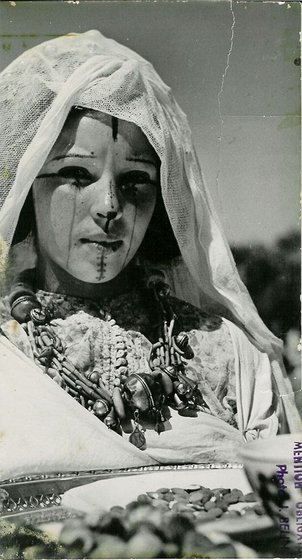
Here are classic images of Berber Jews


[Source: Public Domain, https://commons.wikimedia.org/w/index.php?curid=2418519     c1900]


Berber Jewish Woman-note use of facial tattoos


[ Source http://www.jewishideasdaily.com/4725/features/the-last-berber-jews/?print  c  1930]


To these were added a growing wave of Jews from Spain—some during the Almohades oppression ( such as the Rambam, Maimonides,) others from the time of the Spanish expulsion and inquisition: the “ Megurashim”, The Expelled Ones”. Jews also came here from Italy at the same time.


Delacroix-Jewish Woman of Algiers [https://commons.wikimedia.org/wiki/File:Eug%C3%A8ne_Delacroix,_Jewish_Woman_of_Algiers_%28Juive_d%27Alger_et_une_rue_%C3%A0_Alger%29,_1838,_NGA_58071.jpg]


from DeLacroix Jewish Wedding in Morocco- [https://commons.wikimedia.org/wiki/File:The_Jewish_Wedding_%28Delacroix%29.jpg]


Notice that Delacroix used Jewish women, because they were freer than their Muslim counterparts to go about unveiled. This openness to the world for women shaped the nature of the Jewish ghetto- the Mellah/M'lach  (cognate to Hebrew, Melach,Salt, perhaps because of salt sellers area).


In the Moslem sections of the old “Medina”, there are no windows to the outside-only to the inside courtyard. There was only a lattice, high above street level, whereby a woman could peek through to see who was at the door. The Jewish balconies were open wide, Jewish women would stand on the balconies, and call out to their neighbors.


(In Israel, Jewish mother’s still shout out to the kids down below form the balcony)


Together, Amazigh and Sephardi shaped the Moroccan Jewish story.


Life under Islam was only comparatively better than under Christianity, so that Jews were always in the status of “dhimmi”, 2nd class, and sometimes, the object of actual physical attacks. The status of Jews went up and down at the whim of the current ruler, and they survived, primarily because they proved to be too valuable to Islamic civilization—the craftsmen, the money lenders( as in Europe) and the merchants capable of doing business in both Muslim and Christian lands, again, just as in Christian Europe.


Europeans needed the Jewish connection for trade with North Africa—

however, when the Europeans discovered the world, and sailing both the Atlantic and the Pacific—the Middle East and Morocco with it, became less important= and so did the Jews.


Nevertheless, when Islamic civilization was at its heyday, Morocco was at the forefront of intellectual development:


The first University- founded by a woman- to issue actual degrees for levels of study:


Al-Qarawiyyin ( from Kairouan,now Tunisia )in Fes was founded as a mosque in 857 or 859 by Fatima al-Fihri, beating Al Azhar in Cairo by a century, and Bologna by 2 centuries! Ibn Khaldun, the medieval father of modern economics, sociology, and historiography, spent time in Fes.


Entrance to Library: [ top line is Berber Tifinagh text]


In tandem, Morocco became a center for Jewish learning:


P 82-83

Rabbi Judah ibn Kuraish … and was

known as the “Father of Hebrew Grammar.” He developed a

new approach to the study of this subject through comparison

with other Semitic languages


Rabbi Dunash ben Labrat, lived in Fez

from 920 to 990. … firmly

established the principle of triple-letter roots for Hebrew verbs

to replace the two-letter theory.


… the symbol of Hebrew scholarship in North Africa was undoubtedly Rabbi Isaac ben Jacob Alfassi (1013–1103), a native of Fez and a graduate of

its Hebrew colleges. He drew up a compendium of the Talmud

which was a synthesis of a thousand years of rabbinical

teaching. …

 His work was studied in Spain, in Provence, in the Rhineland, in Central Europe and in Poland and is still taught in rabbinical schools the world over.


P 101

It was the rabbinical academies of Kairouan, Tunis, Algiers,

Tlemcen and Fez, and the lesser schools that were founded in

other centers throughout the Maghreb, that served as the guardians

and propagators of learning and culture among North African

Jewry. In them is to be found the inner power that sustained

Judaism in the Maghreb through the long centuries of oppression

and humiliation which followed.


Morocco became known as a place of major Kabbalistic Rabbis, and their graves were pilgrimage sites for Muslims as well as Jews, and even for some New Yok Hasidim who were on the plane with us.


The economic status of the Jews went downhill , with many Jews reduced to dire poverty, restricted to the Melah. Until the rediscovery of the value of North Africa to the newly powerful European powers, who now could beat back the Ottomans as well as the Beys of North Africa- and they discovered Jews, as much as the Jews discovered the Europeans, and only as we begin modern times, does the condition of Jews improve. Prior to World War II, the Jewish population of Morocco reached 225,000.


However, as Jews entered the modern era, and they were now identified with the French, there were outbreaks of violence and actual pogroms.


To the credit of King Mohammed V, he protected the Jews against the Vichy French allies of Hitler:

. Morocco’s King Mohammed V met with representatives from Nazi Germany and Vichy France during the Holocaust . The Moroccan King famously stated, there are no Jewish citizens, there are no Muslims citizens, they are all Moroccans. [https://www.jewishvirtuallibrary.org/jews-of-morocco]


Nevertheless, there were outbreaks of violence against Jews, especially in 1948, and Jews began leaving. When Morocco became fully independent from France,1956, the gates were closed shut on them, and only in 1963, were the rest allowed to leave.


Today, there are only about 2500 Jews still living in Morocco, while the bulk of the community is now in Israel, as well as France and even here in LA, including members here at our synagogue. However, the few that remained are very prominent, such as Andre Azoulay, advisor to the king, and many Jews, especially Israelis, have significant business relations with Morocco.


Enough said: Here is a visual tour of some significant Jewish sites in Morocco:


Marakkech:

I found out why Crosby, Stills & Nash loved the Marakkech Express ( we went by van)


Al Azama Synagogue ( The Exiles)  


Classroom


Courtyard


Sign at entrance

“All will know,testify and report that there is no Torah as the Torah from Marakkech


Street Sign: 1492- The Synagoue of the Exiled Ones. Talmud Torah Street #36.


El Azama Synagoue


Bab il Mlach- Gate of the Mlach ( Mellah)


Rabbi Bitoun synagogue balcony-facing the Sook-marketplace.

Open balconies in the Jewish quarter


Dar Ima ( Mom's House) Kosher Restaurant


Fes-


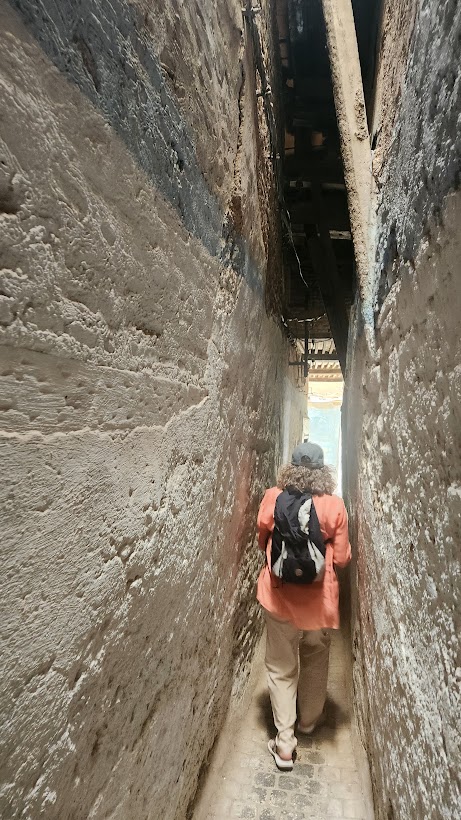
Typical Passageway inside the old city, medina.


A reminder that Morocco is the gateway between Africa and Europe for birds and people on the west, the land of Israel in tandem, on the east.


Aben Danan Synagogue


The AlMemar- the Rabbi’s stand- a uniquely Sephardic element


The Jewish Cemetery-list of great Rabbis buried here since 1672


The grave of    Solicha Hachouel.  Jews call her Sol HaTzaddikah ("the righteous Sol"), while Arabs call her Lalla Suleika or Lalla Zoulikha ("holy lady Suleika").


According to The Jewish Encyclopedia Hachuel "was a martyr to her faith, preferring death to becoming the bride of the sultan.


For more on Sol go to:

http://archive.diarna.org/site/detail/public/2387/


Since her execution, Soulika’s tale of martyrdom has been immortalized across Jewish, Arabic, and European traditions in the form of painting, film, literature, etc. While these accounts of her story vary in detail, the general narrative remains consistent: “She was a young Jewish woman who refused to give up her religion and, because of that refusal, was put to death.”

Alfred deHondencq depiction of the execution of Sol Hatzadika


Rabbi Yehudah ibn Atar


Essauoira( Mogodor) an ancient Jewish trading outpost, now abandoned


A sign of old times- a wine celler belonging to a Jewish merchant, now a restaurant ( building still owned by the Jewish family)


Tribute to Moses Assayag for donating the funds for the school


A mezuzah embedded in the stone wall


A street in the mlach


Jewish student school schedule


Report card!!


There is a Pinto Center, run by the famous Rabbis descendants, here in Los Angeles, on Pico.


A well of water for blessings from the Rabbi


The main synagogue of Casablanca, also Temple Bet El, still in use, but very few local Jews were in actual attendance, mostly there were tourists like us.