Joseph is the
first Hegelian
Video of discussion Jan 7
https://youtu.be/iFFVRnok5ww?t=2312
Jan 14
https://youtu.be/NWJRAg0M4mY?t=7635
Several weeks
ago, when we on Covid break and a few of our members held a zoom gathering
while I was away, the topic of Jacob came up. The question was raised,” How could
we find some redeeming qualities to Jacob?”

Medieval
illuminated manuscript
Jacob and
family
Indeed at
birth, he grabs on to his brother by the heel, buys his birthright, then steals
his birthright, he is involved in convoluted schemes to outwit his scheming father
in law, he wrestles an angle but grovels in front of his brother. When his sons massacre the people of Shechem, he mumbles
his disapproval, not because of morality, but, expediency—the people will take
revenge on us and we are few and weak. His sons are the ones to display
gumption, even if we deplore their action: Our sister is not a prostitute. He
only expresses his anger against the two key sons, Simeon and Levy, on his
deathbed:
Cursed be their anger so fierce,And their wrath so relentless.
I will divide them in Jacob, Scatter them in Israel.( Gen 40 7).
He admits of the
bitterness of his life. When he introduces himself to Pharaoh
מְעַ֣ט וְרָעִ֗ים הָיוּ֙ יְמֵי֙ שְׁנֵ֣י חַיַּ֔י(47:9)
“My years of life have been few and bad”.
It’s a bitter
retrospect on his life: exiled from his
home, tricked into a marriage, losing his favorite wife, losing his favorite
son.
What role does
he play? What purpose in his life? What purpose does any one of us play in our
lives, for that matter?
[Part 2 Jan 14]
On the eve of
Rev MLK Jr Day and Yahrzeit of R ‘AJH
This is a fairly well known
image, of the famous March in Selma Alabama, where the Preacher and the Rabbi
marched arm in arm.

The two were very close, not just in
political terms, but also in a common
religious sensibility.
A propos of this weeks portion, when we begin
the book of Shemot, Exodus, I have this noted paraphrase of the dialog between
Moses and Pharaoh.
His first meeting with Dr. King –
in a conference about religion and race in Chicago, 1963 – he opened his most
famous speech with a Drasha about our Parasha.
: At the first conference on
religion and race, the main participants were Pharaoh and Moses. Moses’ words
were: “Thus says the Lord, the God of Israel, let My people go that they may
celebrate a feast to Me.”
While Pharaoh retorted: “Who is the
Lord, that I should heed this voice and let Israel go? I do not know the Lord.
I will not let Israel go.”
The outcome of that summit meeting has not come
to an end. Pharaoh is not ready to capitulate. The exodus began, but is far
from having been completed.
In fact, it was easier for the children of
Israel to cross the Red Sea than for a Negro to cross certain university
campuses.
But I want to touch on another quotation, this
one from the Rev King,
We
shall overcome because the arc of the moral universe is long but it bends
toward justice. National Cathedral, March 31, 1968
I want to show
where this concept of an arc bending towards justice has its roots.
That takes me
back to the topic I began last week. We talked about the almost fatal flaws of Jacob.
1st-
while we can’t speak for every line of the Bible- we can certainly attest to a
veracity in it. I like to think that one of the best testimonies of the truth
of the text of the Bible is its general honesty.
Everyone
therein has a flaw, sometimes, a fatal
flaw. Our Biblical texts describe a rather ignoble origin of the Jewish people.
Rebels and
disbelievers after the Exodus, the Red Sea and Sinai.
The wild, wild
West ( West of the Mesopotamia) of the period of Judges—again, backsliding,
followed by heroic judges, followed by backsliding again. Tribe against tribe-
Benjamin is almost wiped out. Our English word Shibboleth comes from a verbal
trap used by the Gileadites to kill Ephraimites.
As for the Book
of Kings—it would make Shakespeare’s Kings in his historical plays blush with
envy.
Then, we go to
the Prophets, and we could only say that we never heard any enemy of the Jewish
people use such inflammatory language against us. This wording will be used
against us in the centuries to follow by both Christians and Moslems.
In truth, both
Christian and Muslim scriptures use our very own prophets to attack us.
“ For you suffer the same
things from your compatriots as they did from the Jews,who
killed both the Lord Jesus and the prophets and persecuted us; they do not
please God, and are opposed to everyone,g ( I Thessalonians 2:15)”
“So they were struck with abasement and poverty, and they earned
Allah’s wrath. That, because they would deny the signs of Allah and kill the
prophets unjustly. That, because they would disobey and commit transgressions
(Q 2:61b).”
Why this
glaring honesty. Why this very unvarnished picture of our own history.
It comes from
an underlying theory of history, one which has become the foundation for all
future theories of how the world operates—the Hegelian movement of civilization
to greater liberty, or the Marxist movement of history to a liberation from
economic forces.
It is in our
Torah portion, in a small cycle version:

Medieval engraving,”Pulcher Josephus”-Beautiful Joseph.
Joseph
introduces himself to his brothers, and states:
Now, do not be distressed or
reproach yourselves because you sold me hither; it was to save life that God
sent me ahead of you.Gen 45:5.
He repeats it
now in the last verses of Genesis:
When Joseph’s brothers saw that their father was dead,
they said, “What if Joseph still bears a grudge against us and pays us back for
all the wrong that we did him!”
So they sent this message to Joseph, “Before his death
your father left this instruction:
So shall you say to Joseph, ‘Forgive, I urge you, the
offense and guilt of your brothers who treated you so harshly.’ Therefore,
please forgive the offense of the servants of the God of your father’s
[house].” And Joseph was in tears as they spoke to him.
His brothers went to him themselves, flung
themselves before him, and said, “We are prepared to be your slaves.”
וַיֹּ֧אמֶר
אֲלֵהֶ֛ם יוֹסֵ֖ף אַל־תִּירָ֑אוּ כִּ֛י הֲתַ֥חַת אֱלֹהִ֖ים אָֽנִי׃
But Joseph said to them, “Have no fear! Am I a substitute
for God?
וְאַתֶּ֕ם
חֲשַׁבְתֶּ֥ם עָלַ֖י רָעָ֑ה אֱלֹהִים֙ חֲשָׁבָ֣הּ לְטֹבָ֔ה לְמַ֗עַן עֲשֹׂ֛ה
כַּיּ֥וֹם הַזֶּ֖ה לְהַחֲיֹ֥ת עַם־רָֽב׃
Besides, although you intended me harm, God intended it
for good, so as to bring about the present result—the survival of many people.
And so, fear not. I will sustain you and your dependents.
Thus he reassured them, speaking kindly to them. “(50:15 ff)
We are then
given a hint as why all this has come to pass in the next verses, as Joseph
himself lies on his deathbed:
וַיֹּ֤אמֶר
יוֹסֵף֙ אֶל־אֶחָ֔יו אָנֹכִ֖י מֵ֑ת וֵֽאלֹהִ֞ים פָּקֹ֧ד יִפְקֹ֣ד אֶתְכֶ֗ם
וְהֶעֱלָ֤ה אֶתְכֶם֙ מִן־הָאָ֣רֶץ הַזֹּ֔את אֶל־הָאָ֕רֶץ אֲשֶׁ֥ר נִשְׁבַּ֛ע
לְאַבְרָהָ֥ם לְיִצְחָ֖ק וּֽלְיַעֲקֹֽב׃
At length, Joseph said to his brothers, “I am about to
die. God will surely take notice of you and bring you up from this land to the
land promised on oath to Abraham, to Isaac, and to Jacob.”
וַיַּשְׁבַּ֣ע
יוֹסֵ֔ף אֶת־בְּנֵ֥י יִשְׂרָאֵ֖ל לֵאמֹ֑ר פָּקֹ֨ד יִפְקֹ֤ד אֱלֹהִים֙ אֶתְכֶ֔ם
וְהַעֲלִתֶ֥ם אֶת־עַצְמֹתַ֖י מִזֶּֽה׃
So Joseph made the sons of Israel swear, saying, “When
God has taken notice of you, you shall carry up my bones from here.”
Joseph died at the age of one hundred and ten years; and he was embalmed and placed in a coffin in Egypt. “
Look at how
each event in the lives of the founding fathers and mothers plays out.
Isaac is blind,
and the younger takes over the elder. In the next generation, Jacob is blinded
( by the bride’s veil) and the elder takes over from the younger. Joseph, the younger,
takes over from the older brothers for his father’s affections, and he, in
turn, is stolen from his father. Years later, when Jacob can no longer see, Joseph
brings him his grandsons, and Jacob, blind, blesses the younger first, but this
time, does it knowingly.
Every event has
its opposite reaction-tit for tat- or as the Jewish term is” Midah k’neged midah”,measure
for measure, what goes around, comes around. Fate is arbitrary, blameless;
karma is payback for what was done, unkown and unknowable, in a previous life.
But this is in real time, real life consequences, real time responsibility for ones
actions.
At the same time,
this comedy of errors ,is part of something greater.
We realize that
this entertaining story, from Adam to Noah to Abraham, the tensions between the
siblings in each generation, the squabbles between the wives, each in its way
is setting into motion something much bigger, which Joseph can only begin to
grasp-the descent to Egypt, the enslavement, the liberation , the revelation,
the sanctuary-and in later Jewish, Christian and Islamic theology, leading to
an ultimate redemption of the universe and of humanity.(Mashiach-Messiah-Masikh/Mahdi)
This is the
central point of the great work of philosophy, The Kuzari by R Judah HaLevy. We
learn the general truth of our faith from the particular.
So why do we
have the flawed people instead of the saints to begin with?
King David is a
prime example, much more so than Jacob- David is, in tradition, the “
Arthurian:, Once and Future King, the prototype of the ideal King who will lead
the children of Israel back to glory in the Messianic era. There is David the
ideal, and David the real, especially when compared to his nemesis, King Saul.
Zutra bar Tubia taught in the presence o f Rav Judah.). God told
David, “David, you sing a song on the fall of Saul! If you were Saul, and he
David, how many times would I have destroyed Davids for him!”
…
Said the Holy One to David, “Why do you curse my anointed one? You
say, ‘All my enemies will be frustrated and stricken with terror(Psalm s 6:11).
Do you call Saul an enemy! As it says, “On the day God saved him from the hand
of his enemies, from the hand of Saul ” (II Samuel 22:1). He said to him, “Lord
of the world, intentional sins are before you as mere errors, as you said,
‘Errors, who can understand?’” (Psalms 19:13). (Midrash Tehilim 7:1)
Said Rav Huna: “How little does a person suffer if the Lord helps
him. Saul committed one sin, and was held accountable; David committed two sins,
but was not held liable! Saul with one sin - the incident of Agag. But what of
the incident of Nob? It is after the incident of Agag that the text says, I
repent that I have anointed Saul to be King’ (I Samuel 15:11). What were
David’s two? The killing of Uriah and the incitement (to census, according to
Rashi). Is there not also the incident of Bat Sheva? He paid for it.” (Yoma
22b)
Said Rav Judah in the name of Samuel, “Why did the house of Saul
not continue to reign? Because he had no faults, just as Rav Yohanan in the
name of Rav Shimon bar Yehozedek said, One does not appoint an individual to
the position of leader of the public unless a box of lizards hangs behind him
(a history of sin in the family), so that if his mind errs, they can say, Look
behind you. ”
…
Saul s modesty extended to physical discretion, to the detriment of
David s own lack of shame:
…
Said Rav Huna, “Saul was a year when he became King” (I Samuel
13:1). That means that he never tasted the taste of sin (like a one year old
child). Rav Nachman bar Yitzhak disagreed: “He was like your child, muddied and
soiled with excrement. That night he saw a frightening apparition in his dream,
and he declared, I have disturbed the bones of Saul the son of Kish. The
apparition returned, until he declared, I have disturbed the bones of Saul, the
son of Kish, king of Israel!’ Yoma 22b
( from essay my
essay. Published in Conservative Judaism, Vol. 33 No. 3 Copyright © 1980 by the
Rabbinical Assembly KING SAUL’S FORTUNE AT THE HAND OF THE HOMILISTS )
In other words,
we , in our daily lives, control the micro events. We are held accountable for these.
However, the macro-events- the course of world history, works its own way
around and about us.
I want to
conclude with an essay by noted sociologist, Will Herberg, on the concept of
Bible as History, Heilgeschichte;; Sacred or Salvational history.


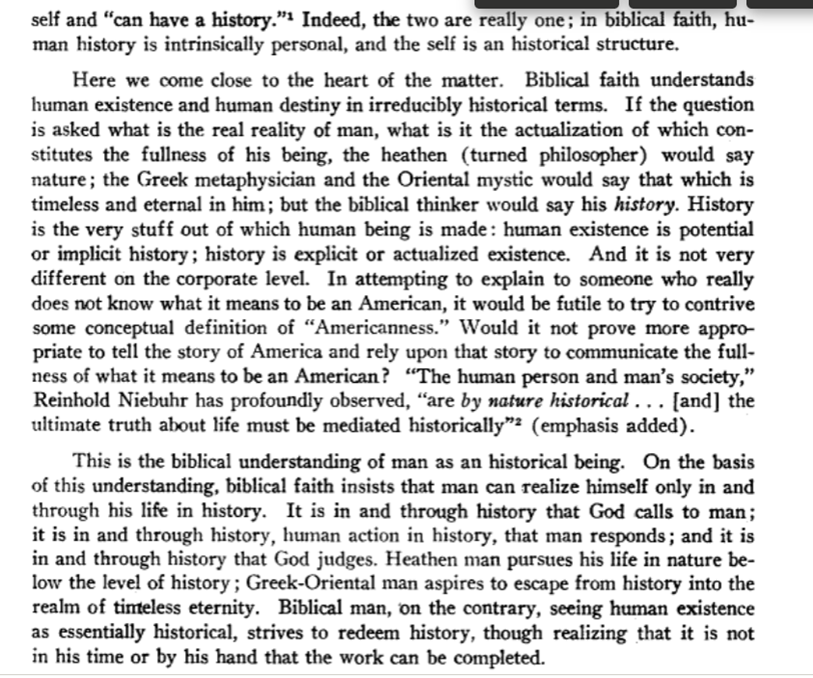
Herberg, Will. “Biblical Faith as Heilsgeschichte: The Meaning of Redemptive History in Human Existence.” The Christian Scholar, vol. 39, no. 1, 1956, pp. 25–31. JSTOR, http://www.jstor.org/stable/41176926. Accessed 5 Jan. 2023.


